

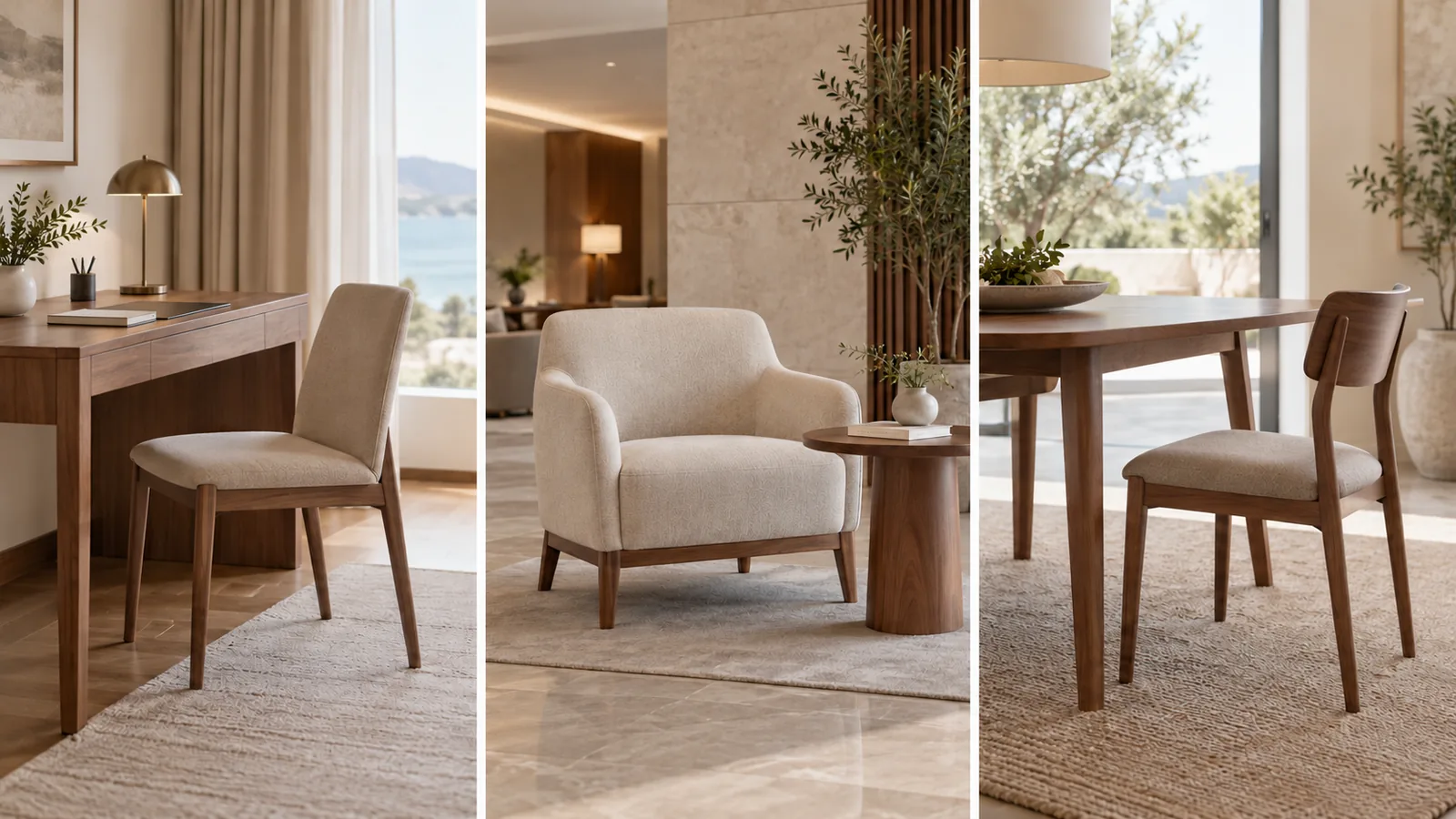
Choose hospitality seating by its intended activity, the space around it and the operator's care requirements. A guestroom chair, lobby lounge chair and dining chair may share a visual style while needing different dimensions, movement and maintenance arrangements. Review each model in its actual setting before treating it as suitable across the hotel.
Start with how people will use the seat. Will they work at a desk, wait with luggage, eat at a table or move the chair frequently? Those questions give the supplier a more useful brief than a photograph alone.
Match the chair to the activity and neighbouring furniture
For a guestroom desk chair, review the chair with the selected desk. Check the relationship between the seat, armrests and underside of the desk, plus the space needed to move the chair. For a lounge chair, examine the surrounding table and the usable room space.
In a lobby, map the seating arrangement against circulation and the operational plan. A chair that looks proportionate in a product image may occupy more space when someone is using it or when luggage sits nearby. Have the responsible designer confirm the layout, including applicable access requirements.
For dining areas, assess the chair and table together. Consider the table base as well as the top; the base can affect where a chair fits. If staff will move or store the seats, include those tasks in the review.
Area | Review in context | Ask the operator about |
|---|---|---|
Guestroom desk | Desk clearance and space to pull back | Cleaning access and movement during room servicing |
Guestroom lounge | Chair, side table and room circulation | Upholstery care and access around the seat |
Lobby | Seating groups, circulation and luggage | Frequent movement, cleaning and component replacement |
Dining area | Seat, table edge and table base | Handling, spills and floor protection |
Flexible event space | Proposed layouts and storage area | Verified stacking or nesting, transport and storage method |
The hotel FF&E checklist can help organise quantities and areas. Keep the functional requirements attached to the individual seating codes.
Ask for evidence that applies to the proposed model
Request the intended-use information and relevant test reports required by the project. Check the model, construction and any stated limits covered by the evidence. A report for a different frame or material combination needs clarification before the team treats it as applicable.
BIFMA's notice on ANSI/BIFMA X5.4 describes a standard for public and lounge seating, including indoor settings such as waiting, reception and dining areas. It is one possible project reference, not proof that a particular chair has been tested or that the same requirements apply in every market.
Ask the responsible specification team which requirements apply to the location and use. Keep material, seating performance and any applicable fire requirements distinct. Do not substitute a marketing description such as "commercial grade" for the evidence the project has requested.
Treat abrasion results as one part of upholstery selection
An abrasion number is easy to compare, but it does not describe the entire fabric or the finished seat. The Association for Contract Textiles abrasion guidance cautions that higher abrasion results do not necessarily predict a longer service life. A result twice as high should not be read as a promise of twice the life.
Review the selected fabric's other relevant properties, the intended application and its care instructions. Ask about the proposed upholstery construction and any limitations of the material. Where the project requires specific testing, confirm that the information covers the product being offered.
Let the operator review a physical sample. Colour and texture matter, but so do the cleaning method and whether the operator can follow it. Use the material manufacturer's instructions rather than assuming that one cleaning product suits every upholstery option.
Include the parts that touch the floor and the staff
Review glides, feet or castors with the specified floor finish and the intended movement. Ask the supplier about suitable options and replacement availability. The responsible project team should confirm compatibility rather than selecting a detail from appearance alone.
If stacking is required, request the manufacturer's permitted arrangement and handling instructions. A chair should not be treated as stackable simply because two samples can be placed together. Check the storage space and the equipment needed for the approved method.
Consider what staff must do during cleaning or room resets. Ask them to try a sample where practical. A product review can include handling and access without inventing a universal weight limit or a fixed number of chairs one person should move.
Make the sample review specific
As an illustrative example, a hotel selects one dining chair for both restaurant tables and guestroom desks. The chair works at the dining table, but its arms do not fit under the chosen desk. The project now needs a different chair, an approved variation or a different desk arrangement.
A review of the chair by itself would miss that conflict. Place it with the actual neighbouring furniture or an accurate representation. Record the model, material and dimensions of the tested combination so the approval can be traced to the ordered products.
Include appearance, comfort feedback and operational observations, but distinguish preferences from measurable requirements. The mock-up room approval guide provides a structure for recording room-level decisions.
Keep the replacement discussion practical
Ask which components can be replaced and what information the hotel should retain. The answer may differ for a glide, upholstery panel or complete seat. Record the product code and approved material references rather than relying on a generic description such as "lobby chair."
Discuss later availability without assuming a permanent supply commitment. If continuity matters, ask about spare components or how a future substitution would be reviewed. Those arrangements belong in the order discussion.
Can one chair model serve several hotel areas
Yes, if it meets the requirements of each use and works with the surrounding furniture. Review every proposed setting rather than extending an approval from one room automatically.
Does a high abrasion result make a fabric suitable
Not by itself. Consider the intended use, other relevant material properties, upholstery construction and the cleaning requirements. Obtain the evidence specified for the project.
Send Grandmeca the seating areas, quantities and furniture layouts to discuss the proposed package. Add the operator's care needs and the project testing requirements so the enquiry covers more than appearance.
By Grandmeca


