

A hotel FF&E checklist should show what each space needs, how many items to buy and who is responsible for them. A list of furniture names is a starting point. For an enquiry, it also needs room types, item references and a clear indication of what is confirmed.
FF&E means furniture, fixtures and equipment. This checklist focuses on the furniture portion of a hotel project. Use it to prepare for hotel FF&E procurement, then adjust it to the property's layouts, operating needs and agreed scope. It is not a hotel brand standard or a promise that one supplier provides everything listed.
Start with the spaces, not the catalogue
List the spaces included in this purchase before selecting products. Separate room types and identify any rooms with different layouts. A suite, a standard guestroom and a room with project-specific accessibility requirements may need different furniture schedules.
For a renovation, record what stays, what will be refurbished and what needs replacing. Otherwise, a complete room list can be mistaken for a complete new order.
Use a simple status for each space: included, excluded or awaiting a decision. If a restaurant belongs to a separate operator, for example, confirm its purchasing responsibility rather than quietly deleting it from the overall checklist.
A furniture checklist by hotel area
The following items are prompts for scope review. They are not mandatory contents for every hotel.
| Area | Furniture to consider | Questions to resolve |
|---|---|---|
| Guestroom sleeping area | Bed bases, headboards, bedside tables | Are mattresses separate? Are headboards freestanding or fixed? |
| Guestroom storage and work area | Wardrobes, desks, luggage benches, television or minibar cabinets | Are appliances included? Which dimensions need site confirmation? |
| Guestroom seating | Chairs, side tables, sofas where required | Which room types use each item? Is upholstery specified? |
| Suites | Additional seating, dining furniture and storage where shown | Are these additional pieces or replacements for the standard-room set? |
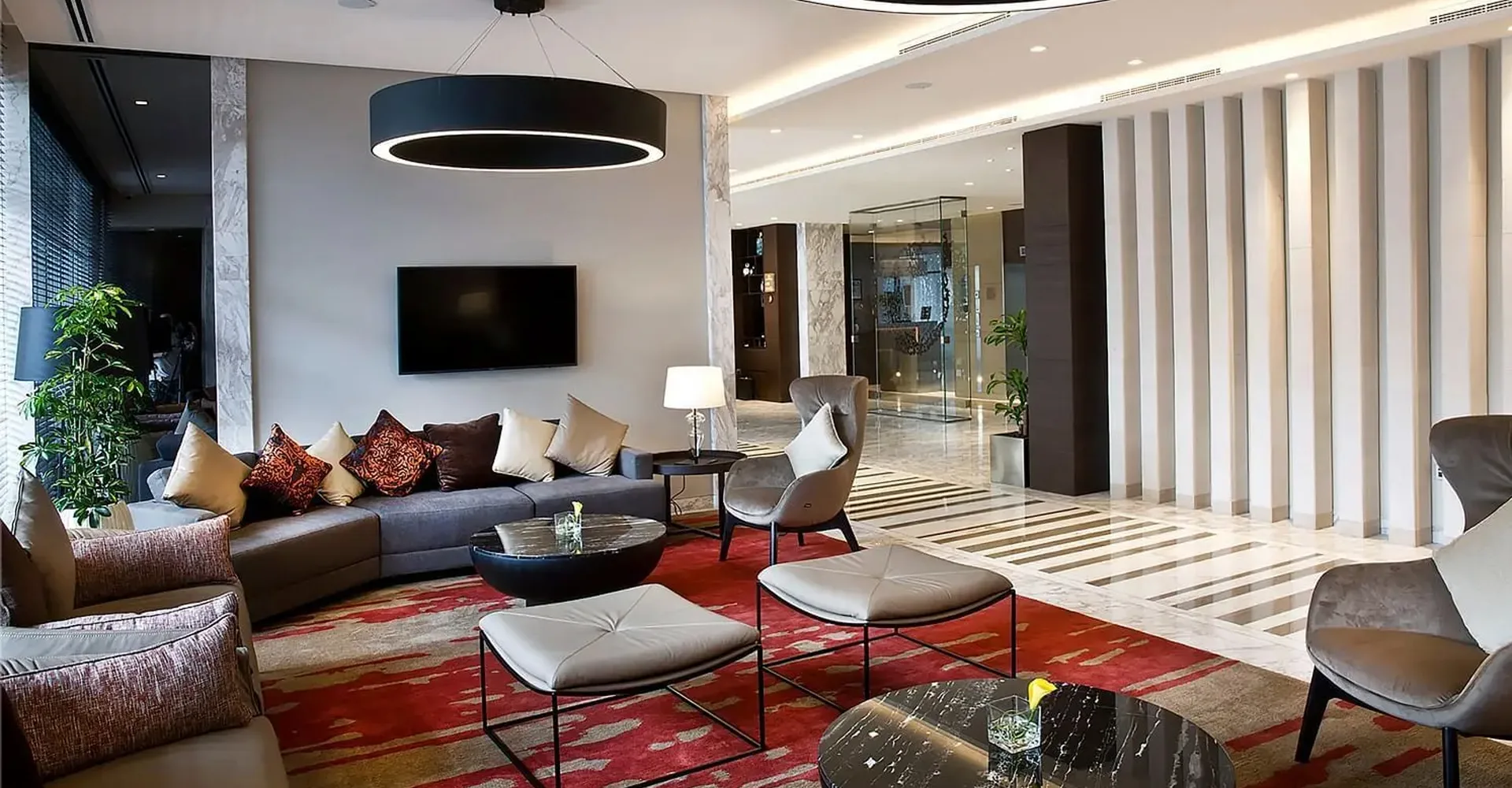
| Lobby and reception | Reception desk, lounge seating, coffee and side tables | Who provides built-in elements and coordinates adjacent services? |
| Dining and bar areas | Dining chairs, tables, banquettes and service furniture | Who confirms layouts, quantities and equipment interfaces? |
| Meeting and event spaces | Meeting tables, chairs and storage | Are handling and storage needs defined? Are audiovisual items separate? |
| Staff and support areas | Desks, seating, lockers or storage within the brief | Is this part of the same order? |
Bathroom furniture, decorative lighting, curtains, rugs and artwork may also appear in a wider FF&E schedule. List them where they belong in the project, but identify the responsible procurement scope. Their presence on a checklist does not make them part of a furniture supplier's quotation.
Count by room type and keep the units visible
For repeated guestrooms, calculate an item's base quantity from the number of applicable rooms and the units required in each room. Then record any approved spare quantity separately. Public-area quantities should come from their own layouts rather than a guestroom multiplier.
Be clear about the unit of purchase. A bedside table counted individually is different from a pair; a bed base is different from a complete bed set. An item description should not leave that distinction to the person preparing the quotation.
If one wardrobe design has left-hand and right-hand versions, give those versions separate references where they affect manufacturing. A combined total can remain useful for reporting, but the order must still say how many of each version are required.
Keep a quantity revision date and a source reference. When a room mix changes, the reviewer should be able to trace which furniture totals need updating.
Give every line enough information for a quote
A useful checklist connects to more detailed specifications rather than trying to include every drawing. The fields below form an illustrative structure, not an actual client BOQ.
| Field | What to record |
|---|---|
| Area and room type | Where the item belongs |
| Item reference and description | A consistent identifier and plain description |
| Unit and quantity | Each, pair or set, with the scope of a set defined |
| Specification reference | Relevant dimensions, materials, finish or linked document |
| Drawing revision | The version suppliers should use |
| Supply and site responsibility | Who supplies, receives and installs, where applicable |
| Decision status | Confirmed, preliminary or awaiting clarification |
| Exclusion or assumption | Anything that would otherwise be left for the supplier to guess |
Keep unknown information visible. Writing "finish to be confirmed" is more useful than allowing several suppliers to choose different finishes without saying so.
For custom joinery, reference the relevant drawings and identify who checks site dimensions. A wardrobe shown in an image is not, by itself, a complete manufacturing instruction.
Separate the furniture from adjacent work
Some omissions happen at the boundary between packages rather than inside a furniture list. Check these boundaries explicitly:
- The cabinet and the appliance it contains.
- The headboard and electrical fittings around it.
- The furniture item and the fixings or installation work.
- The reception desk and equipment used behind it.
- The bed base, mattress and linens.
Record both sides even if different suppliers handle them. For a minibar, the cabinet can appear in the furniture schedule while the refrigerator appears in an equipment package. Someone still needs to confirm that the two fit together.
Operating supplies such as towels, tableware and toiletries should fall under their own responsible team and purchasing scope. Do not treat them as covered simply because the overall project uses the term FF&E.
Review the checklist before sending it out
Walk through each included space against the latest layout. Check that every listed item has a quantity, a usable reference and a stated document status. Confirm that retained renovation furniture has not become a new purchase by mistake.
Then review the boundary items with the relevant project parties. An unresolved responsibility item should remain an open item with an owner, not disappear into a general note.
Send the same checklist version to everyone quoting. If the list changes, identify affected references and ask suppliers to confirm whether their prices and quantities need to be updated.
Common questions
Is a hotel FF&E checklist the same as a BOQ?
They can overlap. A checklist helps establish scope and completeness; a Bill of Quantities (BOQ) records the items and quantities for the defined purchase. A checklist becomes more useful for quoting when it includes consistent references and links to specifications.
Should the checklist include spare furniture?
Record spares if the project approves them, but keep them separate from the base quantities. Do not apply a universal spare percentage without checking the operator's needs, storage and purchasing decision.
Can we send the checklist before the design is complete?
Yes. Mark preliminary items, missing specifications and unresolved scope. Ask the supplier which information is needed for a budget discussion and which details must be confirmed before an order can proceed.
Prepare your furniture list for a scope review
Share the project location, room mix, included public areas and the checklist you have. Add available drawings and identify the items that are still undecided.
Grandmeca can review the proposed furniture scope with you. A clearly labelled preliminary list gives that conversation a useful starting point without pretending that every detail is final.


